A small band of tissue beneath the tongue should never be powerful enough to affect how a child eats, speaks, or develops. Yet for thousands of families, that is exactly what happens. Tongue tie, formally known as ankyloglossia, is a congenital condition in which a shortened or thickened lingual frenulum restricts the tongue’s range of motion, and its effects can reach far beyond infancy if left unaddressed.
At Legacy Oral Surgery Group, we provide tongue tie evaluations and frenectomy procedures for patients in Staten Island and the surrounding area. Led by Dr. Nancy Herbst, an oral and maxillofacial surgeon with more than 25 years of experience, our team treats patients from newborns to adults with the precision and personalized attention that this condition demands. Our oral surgery treatments in Staten Island encompass the full scope of soft tissue procedures, and tongue tie release is one of the most impactful services we deliver to Staten Island families.
What Is A Tongue Tie and Who Does It Affect?
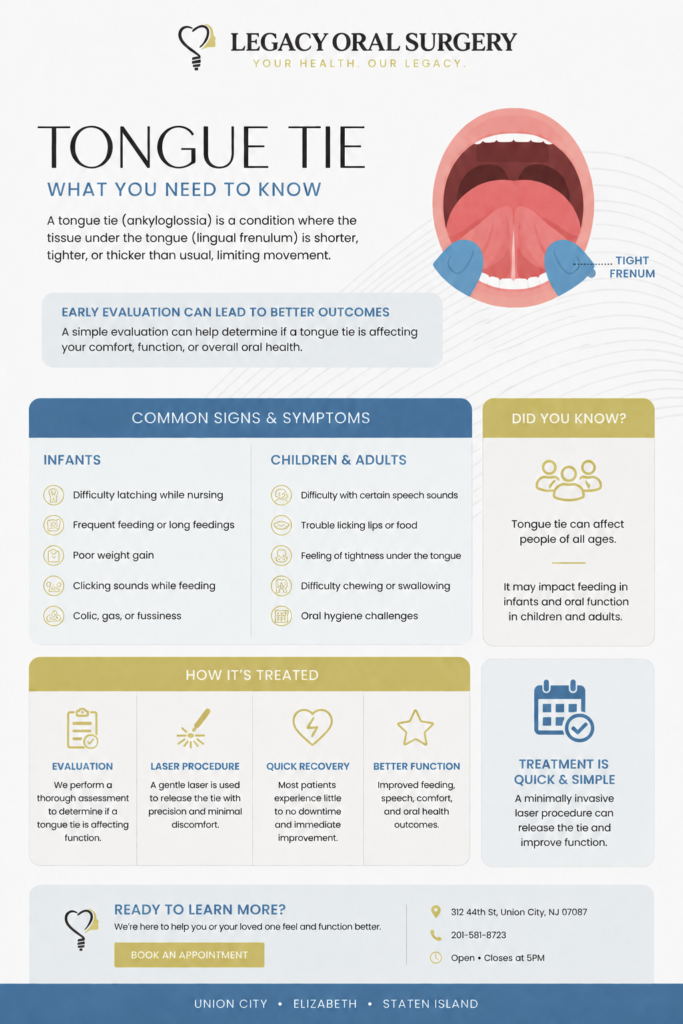
Tongue tie occurs when the lingual frenulum, the thin strip of tissue connecting the underside of the tongue to the floor of the mouth, is abnormally short, thick, or tight. This limits the tongue’s ability to move freely, which can interfere with a range of functions. According to research published on the NIH’s StatPearls platform, ankyloglossia affects multiple aspects of oral function and involves specialists from several medical and dental disciplines.
Who Can Be Affected
Tongue tie is not limited to infants, though it is most commonly identified in newborns struggling with breastfeeding. Older children and adults can also live with the condition undiagnosed for years before the functional impact becomes apparent. Those who may benefit from an evaluation include:
- Infants: Who have difficulty latching, experience poor weight gain, or cause significant nipple pain during breastfeeding
- Toddlers and young children: Whose speech development shows signs of difficulty with sounds requiring tongue elevation or tip movement
- School-age children and adults: Who experience jaw tension, difficulty chewing certain foods, or limited tongue mobility that affects daily quality of life
No matter the age, the right evaluation can reveal whether a frenectomy may help restore normal function and comfort
How Is Tongue Tie Diagnosed and Treated in Staten Island?
When you bring your child or yourself in for a tongue tie evaluation at our Staten Island office, our team conducts a thorough clinical assessment of tongue mobility and frenulum attachment. We consider the degree of restriction, the patient’s age, and any functional concerns before recommending a course of action.
The Frenectomy Procedure
When treatment is recommended, a frenectomy is the standard surgical approach. This procedure involves releasing the lingual frenulum to allow the tongue greater freedom of movement. For infants, the procedure is typically quick and performed with minimal discomfort. For older children and adults, local anesthesia is used to ensure comfort throughout the procedure. We perform frenectomy procedures with care for both clinical outcomes and the patient’s overall experience.
Recovery after a frenectomy is generally straightforward. Most patients are discharged the same day, and postoperative instructions guide families through any exercises or care steps that support proper healing and improve tongue mobility.
Why Early Treatment Matters
Delaying treatment for tongue tie can have lasting consequences for development. In infants, breastfeeding difficulties tied to poor latch can disrupt nutrition and bonding. In children, restricted tongue movement may contribute to speech delays, compensatory articulation patterns, and even changes to dental alignment over time. Adults who have lived with undiagnosed ankyloglossia may notice chronic jaw discomfort or limitations that they had simply accepted as normal.
Addressing tongue tie early, when identified, gives patients the best opportunity for improved function across the board. Our team approaches each case individually, weighing the clinical picture against what matters most to each patient and family.
Choosing the Right Surgeon for Tongue Tie Release in Staten Island
Tongue tie release is a soft tissue procedure that requires precision and experience with oral anatomy. Selecting a surgeon with deep familiarity with frenulum release across all age groups is important, particularly for infants, where even the smallest technical details matter.
Our Staten Island location serves families throughout the borough and neighboring communities who want access to a practice with both the clinical qualifications and the patient-centered approach to make this experience as smooth as possible. We see over 7,000 patients annually and bring more than 35 years of combined professional experience to every procedure we perform.
Legacy Oral Surgery Group: Tongue Tie Care in Staten Island
Legacy Oral Surgery Group has built its reputation on delivering high-level oral surgical care with a genuine commitment to patient comfort. Dr. Nancy Herbst leads our team with over 25 years of oral and maxillofacial experience, and she has treated patients ranging in age from newborn to 103 years old. That breadth of experience means we are equipped to handle tongue tie cases at any stage of life, from the first days after birth to adulthood.
We use the latest equipment and surgical techniques, and we are with our patients before, during, and after their procedure. Our office staff is also available to assist with insurance questions and paperwork so that financial concerns do not stand in the way of the care your family needs. To schedule a tongue tie consultation at our Staten Island practice, contact our office, and our team will help you take the next step.