Medically Reviewed by Dr. Nancy Herbst, DDS
3D printing can shorten several of the planning and lab steps in dental implant treatment, but it does not change how fast your jawbone heals. Digital scans, printed models, printed surgical guides, and printed temporary teeth can cut down on waiting between appointments and help the surgical team plan placement more precisely. The longest part of most implant timelines, the months the implant spends bonding with bone, still depends on your body. Knowing which steps technology can compress, and which it cannot, gives you a far more realistic picture of how long treatment may take.
At Legacy Oral Surgery, our oral and maxillofacial surgeons place dental implants for patients at our offices in Staten Island, NY, and Elizabeth and Union City, NJ. Our implant planning relies on 3D digital imaging technology and computer-guided surgical planning, so we see firsthand how digital tools have changed the way implant cases come together. Below, we walk through where 3D printing fits into the process, what the research says about its accuracy, and what it can and cannot do for your timeline.
Where the Time Goes in a Typical Implant Timeline
Before looking at what 3D printing changes, it helps to see the full sequence. A dental implant is a small titanium post placed in the jawbone to act as an artificial tooth root, with a crown, bridge, or denture attached on top once the post is stable. Most cases move through some version of these stages:
- Consultation and imaging: An exam, a review of your health history, and 3D scans of the jaw to measure bone and locate nerves and sinuses.
- Preparatory procedures: Extractions, bone grafts, or a sinus lift when the existing bone cannot support an implant yet.
- Implant placement: The surgery itself, which for a single implant is often a fairly short appointment.
- Osseointegration: The healing period in which bone grows around and fuses with the implant surface.
- Final restoration: Impressions or scans for the permanent tooth, fabrication, fitting, and adjustments.
Some of these stages are driven by logistics, such as how long a lab needs to fabricate a model or crown. Others are driven by biology, such as graft healing and osseointegration. 3D printing mainly affects the logistical stages. That distinction is the key to setting realistic expectations.
What 3D Printing Actually Does in Implant Dentistry
3D printing, also called additive manufacturing, builds an object layer by layer from a digital design file. In implant dentistry, that design file usually starts with two kinds of data: a 3D image of the jaw and a digital scan of the teeth and gums. Combined in planning software, these give the surgeon and restoring dentist a detailed virtual model of the mouth.
Digital Scans in Place of Putty Impressions
Many practices now use intraoral scanners, small handheld cameras that capture the shape of the teeth and gums, in place of traditional impression trays filled with putty. A digital scan can be sent to a lab or design team the same day instead of being shipped as a physical mold. For patients, it also tends to be more comfortable than biting into impression material, especially for anyone with a strong gag reflex.
Printed Models and Surgical Guides
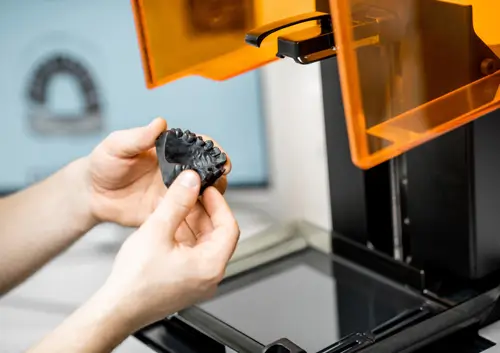
Once a plan is set, a 3D printer can produce a physical model of the jaw or a surgical guide. A surgical guide is a thin custom template that fits over the teeth or gums and has openings, often with metal sleeves, that steer the drill to the planned position, angle, and depth. Static guides like these can be made by printing or by milling from a solid block. When a lab or practice prints guides in house, the turnaround between planning and surgery may be shorter than waiting on an outside lab.
Printed Temporary Teeth
3D printing is also used to make provisional restorations, the temporary crowns, bridges, or dentures a patient wears while the implant heals. Because they come from the same digital plan, temporaries can sometimes be ready by the day of surgery when the case allows it.
Which Steps 3D Printing Can Shorten, and Which It Cannot
The honest answer is that 3D printing compresses the waiting that happens between appointments, not the healing that happens inside the bone. Digital scans, in-house design, and printed guides or models can reduce the number of days spent waiting on fabrication and shipping. In some cases, they may also reduce the number of visits needed for impressions and try-ins, since a digital file can be adjusted on screen rather than remade by hand.
What 3D printing does not change is osseointegration. Bone needs time to grow onto the implant surface, and that pace depends on factors such as bone density, the location in the mouth, overall health, smoking, and whether grafting was needed first. If a graft is required, the graft site also has to heal before an implant can go in, which adds time to the front of the process. Technology can help the surgeon plan around these factors, but it cannot rush them.
For that reason, we encourage patients to be cautious with any promise that a printed part alone will make implant treatment dramatically faster. Our article on the stages of dental implant healing explains what is happening in the bone during that waiting period and why it matters for the long-term stability of the implant.
Ready to Schedule Your Consultation?
Our oral surgeons are here to help you find the right treatment. Schedule your appointment today.
Surgical Guides and Accuracy: What the Research Shows
The strongest case for digital planning is accuracy, not speed. A 2023 systematic review in the International Journal of Implant Dentistry pooled 41 studies on digital surgical guides published between 2018 and 2022. The authors found that guided implant surgery placed implants with an average positional deviation under 2 millimeters from the plan, with most studies under 1 millimeter, and an average angular deviation under 8 degrees, with most under 5 degrees.
The same review found that the way a guide is supported matters. Guides that rest on teeth on both sides of the gap showed the highest accuracy in lab testing, while guides that rest only on the gums showed the lowest accuracy in patients, likely because soft tissue moves and compresses. Interestingly, milled guides showed somewhat better accuracy in patients than 3D-printed guides, though the authors noted that more data is needed and that the field still lacks a universal standard for measuring accuracy.
The takeaway for patients is that the digital plan and the surgeon’s judgment matter more than any single manufacturing method. A printed guide is a tool for carrying out a well-made plan, and that plan starts with good imaging. Our post on why pre-surgical planning is critical for dental implants goes deeper into what happens before the day of surgery.
How Precise Planning May Support Comfort and Recovery
When placement is planned in detail ahead of time, the surgeon knows in advance where the bone is thickest and where nerves and sinuses sit. In some cases, that allows a more conservative approach, such as placing an implant through a small opening in the gum rather than lifting a larger flap of tissue. Less disruption to the gums may mean less swelling and tenderness for some patients in the first days after surgery.
Accurate placement also supports the restoration that comes later. An implant positioned at the planned angle and depth gives the crown or bridge a better foundation, which can reduce the need for adjustments when the final tooth is fitted. Results vary from patient to patient, and a guide does not remove the normal risks of surgery.
Cost and Access: A Realistic View
Earlier writing about 3D printing often suggested it makes implants cheaper across the board. The reality is more mixed. Digital workflows can reduce material waste and remakes, and in-house printing can cut down on outside lab steps. At the same time, scanners, printers, software, and 3D imaging equipment carry real costs, and the number of implants, grafts, and the type of final restoration still drive most of what a patient pays.
The more meaningful benefit for many patients is predictability. When the plan is mapped digitally, you can often see a clearer outline of the steps, the number of visits, and whether any preparatory procedures are likely before treatment begins. Your consultation is the right place to ask how imaging and planning will be used in your case and how they may affect your schedule and costs.
How Our Team Plans Implant Treatment
Every implant case at Legacy Oral Surgery starts with a consultation and 3D imaging of the jaw. Our team, led by Dr. Nancy Herbst, uses that imaging along with computer-guided surgical planning to map implant position before the procedure begins. That planning is what allows us to tell you up front whether grafting or other preparation may be needed and to give you a realistic estimate of your timeline.
Depending on the procedure and your needs, sedation options are available, and our surgeons will review them with you. From a single missing tooth to a full-arch restoration, each plan is built around your anatomy and goals rather than a fixed schedule.
Take the Next Step Toward Your New Smile
Dr. Herbst and our team bring over 25 years of experience in oral and maxillofacial surgery to every implant case, with care that continues before, during, and after your procedure. We use detailed 3D imaging and computer-guided planning to help each implant go where it belongs and to give you an honest picture of how long your treatment may take.
If you are considering dental implants and want to know what your own timeline might look like, our offices in Staten Island, Elizabeth, and Union City are ready to help. To schedule a consultation, please fill out our contact form.
Frequently Asked Questions About 3D Printing and Dental Implants
Does 3D printing make dental implants heal faster?
Not directly. Osseointegration, the process of bone fusing with the implant, follows its own biological pace that depends on bone quality, health, and habits like smoking. 3D printing mainly shortens planning and fabrication steps. Precise planning may allow a less invasive surgery in some cases, which can help with early comfort, but it does not speed up the bone healing itself.
What is a surgical guide for dental implants?
A surgical guide is a custom template that fits over your teeth or gums during surgery. It has openings that direct the drill to the position, angle, and depth planned on your 3D scans. Guides can be 3D printed or milled. They are designed to help the surgeon carry out a digital plan accurately, and whether one is used depends on the case.
Can I get a temporary tooth on the same day as my implant?
Sometimes. A temporary tooth can be attached right away only when the implant is very stable at placement and the bone can handle the load. Many patients instead wear a removable temporary or wait for healing first. Your surgeon decides based on your scans and what is found during surgery, so it is best discussed at your consultation.
How long does the dental implant process usually take?
It varies widely. When the bone is healthy and no grafting is needed, treatment often takes several months, and most of that time is healing after placement. Extractions, bone grafts, or a sinus lift can add months to the front of the process. Your consultation and 3D imaging are what allow your surgeon to give you a realistic estimate.
Are digital scans better than traditional impressions?
For many patients, digital scans are more comfortable because there is no tray of impression material to bite into. The files can also be shared with a lab right away instead of being shipped. Traditional impressions are still accurate and are still used in some situations, so the best method depends on the case and the restoration being made.
About the Author
Oral and Maxillofacial Surgeon | Owner, Legacy Oral Surgery
Dr. Nancy Herbst has more than 25 years of experience and leads the team of oral and maxillofacial surgeons at Legacy Oral Surgery. She earned her Doctorate of Dental Surgery from New York University College of Dentistry and served as Chief Resident in the Department of Oral and Maxillofacial Surgery at Jersey City Medical Center.