Medically Reviewed by Dr. Nancy Herbst on September 24, 2026
You may be a good fit for All-on-4 if you are missing most or all of the teeth in one arch, or your remaining teeth in that arch cannot be saved, you want fixed teeth instead of a removable denture, you are healthy enough for implant surgery, and imaging shows enough bone in the front of your jaw to anchor four implants. If several of those points do not apply to you, another option, such as implant-supported overdentures, an implant-supported bridge, or grafting before implants, may suit you better. The decision is made with your oral surgeon after an exam and 3D imaging, but you can learn a lot before that visit by asking yourself the right questions.
The best way to confirm whether All-on-4 is appropriate for your specific situation is to consult with an experienced oral surgeon. At Legacy Oral Surgery & Implants, Dr. Nancy Herbst and our team take a thorough, individualized approach to every evaluation, factoring in your bone, overall oral health, medical history, and personal goals before recommending any treatment plan. This guide focuses on the decision itself: the signs that point toward All-on-4, the signs that point elsewhere, and what to ask at your consultation.
What Is the All-on-4 Procedure?
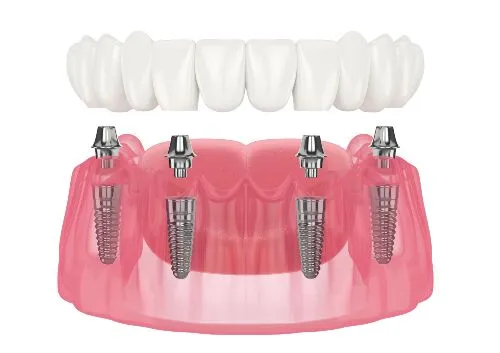
All-on-4 is a full-arch tooth replacement technique that uses four implants, strategically angled, to support a complete fixed bridge of replacement teeth. Two implants are placed toward the front of the jaw and two are angled further back, a positioning that takes advantage of the denser bone typically found toward the front of the jaw. This design allows many patients to receive a full arch of new teeth without the bone grafting that older implant techniques often required.
Because the replacement teeth are fixed in place rather than removable, All-on-4 functions much more like natural teeth than a traditional denture, both in appearance and in day-to-day use. For a full overview of the technique, recovery, and long-term maintenance, see our guide to everything you need to know about All-on-4 dental implants.
Questions to Ask Yourself Before Your Consultation
Thinking through a few practical questions ahead of time makes your consultation more productive and helps you see whether All-on-4 matches what you want from treatment.
How Many of Your Teeth Can Still Be Saved?
All-on-4 replaces an entire arch. If most of your teeth in the upper or lower jaw are missing, loose, or failing from decay or gum disease, a full-arch solution often makes sense. If only a few teeth are missing and the rest are healthy, keeping your natural teeth and replacing the gaps with individual implants or an implant-supported bridge is usually the more conservative choice.
What Bothers You Most About Your Current Teeth or Denture?
Patients who choose All-on-4 often describe a denture that slips while eating or speaking, sore spots, reliance on adhesive, or a diet limited to soft foods. If your main goal is fixed teeth you do not take out at night, All-on-4 is designed for that. If you are comfortable with a removable appliance and mainly want better stability, implant-supported overdentures may meet your needs with fewer implants.
How Is Your Overall Health?
Implant surgery requires that you heal well afterward. Conditions such as poorly controlled diabetes, smoking, and some medications that affect bone or healing can raise the risk of complications, so your surgeon will review your full medical history. Our article on medications that can interfere with oral surgery or implants explains which prescriptions are worth mentioning at your visit.
Are You Ready for the Daily Care and Follow-Up?
A fixed full-arch bridge still needs daily cleaning underneath and regular professional checkups. Patients who commit to that routine give their implants the best chance of lasting for many years.
Who Is a Good Candidate for All-on-4?
The All-on-4 procedure is designed for patients who are missing most or all of their teeth in the upper or lower arch, or for those whose remaining teeth are severely compromised and cannot be saved. Strong candidacy indicators include the following.
- Multiple missing teeth or a failing arch: All-on-4 is most beneficial for patients who need an entire arch replaced rather than one or two individual teeth.
- Adequate bone in the front of the jaw: The four implants are typically placed in areas of the jaw where bone is naturally denser, allowing many patients to bypass the need for bone grafting.
- Good general health: Successful implant surgery requires that patients be healthy enough to undergo a surgical procedure and heal properly afterward.
- Dissatisfaction with removable dentures: Patients who are frustrated with the instability, discomfort, or dietary restrictions of conventional dentures often find All-on-4 to be a meaningful improvement.
- Non-smokers or those willing to quit: Smoking significantly increases the risk of implant failure. Patients who smoke are encouraged to quit before and after the procedure.
How Your Candidacy Is Confirmed
Understanding what happens during evaluation and treatment can help you make a more confident decision. The All-on-4 process typically follows these phases, and our article on what to expect during the All-on-4 implant process covers each stage in more detail.
- Comprehensive evaluation: Your oral surgeon will review your dental and medical history, take digital X-rays or a CT scan, and assess your bone structure and overall health.
- Treatment planning: A customized surgical plan is developed based on your unique anatomy. The four implant positions are mapped out to maximize stability and avoid the need for sinus augmentation or bone grafting in most cases.
- Implant placement: On the day of surgery, any remaining compromised teeth are extracted, and four titanium implants are placed into the jawbone. A temporary fixed bridge is typically attached the same day when the implants are stable enough to support it.
- Healing and osseointegration: Over the next several months, the implants fuse with the surrounding bone through a process called osseointegration. This creates the durable foundation that makes All-on-4 a long-term solution.
- Permanent restoration: Once healing is complete, the temporary bridge is replaced with your final, custom-fabricated prosthesis designed to look, feel, and function like natural teeth.
The evaluation step is where your candidacy is actually decided. 3D imaging shows how much bone is available, where the sinuses and nerves sit, and whether the implants can be angled to avoid grafting. That information is what turns a general sense that All-on-4 might work into a specific recommendation.
Benefits of Choosing All-on-4 Over Dentures
Traditional removable dentures have long been the default for full-arch tooth loss, but they come with well-known limitations. All-on-4 dental implants address many of those limitations by providing the following.
- A fixed, non-removable restoration that stays in place while eating, speaking, and laughing
- The ability to bite and chew with forces closer to natural teeth
- Stimulation of the jawbone to help prevent ongoing bone resorption
- No adhesives, no soaking, and no slipping
- A more natural appearance and improved confidence
- Simplified maintenance, brush and floss as you would with natural teeth
For patients weighing how many implants their situation may call for, our overview of how implants are determined for full mouth tooth replacement explains how All-on-4 compares to other full-arch options.
All-on-4 Versus Traditional Multiple Implants
Some patients missing a full arch of teeth are also candidates for a restoration supported by six or eight individual implants rather than four. That approach can offer additional support in certain cases, but it typically requires more bone volume and, often, bone grafting beforehand. All-on-4 was specifically designed to reduce or eliminate that need by angling the rear implants into denser bone.
Peer-reviewed research following All-on-4 patients over several years has generally found high implant survival rates when patients maintain regular oral hygiene and follow-up care, making it a well-studied option for full-arch replacement rather than an experimental one. Results still vary from person to person, which is why a careful evaluation matters.
Are There Reasons All-on-4 May Not Be Recommended?
All-on-4 is not the right fit for every patient. Your oral surgeon may recommend alternative approaches if you have severe bone loss throughout the entire jaw, though bone grafting may still make implants possible, certain uncontrolled systemic health conditions, or if only a few teeth need replacement and individual implants are a better fit.
Alternatives Our Team May Discuss
Depending on your exam, alternatives can include implant-supported overdentures, which snap onto implants but can be removed for cleaning, implant-supported bridges for several missing teeth in a row, or bone grafting and sinus lift procedures to build up bone before implants. Our comparison of dental implants and implant-supported dentures walks through how those choices differ in cost, care, and feel.
An in-depth evaluation at Legacy Oral Surgery & Implants is the only reliable way to determine which solution aligns with your oral health needs and long-term goals. Our team will walk you through all your options so you can make an informed decision at every stage of the process.
Questions to Ask at Your All-on-4 Consultation
Bringing a short list of questions helps you compare options clearly. Consider asking whether your imaging shows enough bone for All-on-4 without grafting, whether a temporary bridge can be placed the same day in your case, what the full cost includes from surgery through the final bridge, how long the temporary phase is expected to last, and what follow-up and cleaning schedule you will need. Your surgeon can also explain how sedation options may be used to keep you comfortable during surgery.
Schedule Your All-on-4 Consultation at Legacy Oral Surgery & Implants
If you are ready to take the next step toward a permanent, fixed smile, the team at Legacy Oral Surgery is here to guide you. We serve patients across New Jersey and Staten Island from our Union City, Elizabeth, and Staten Island locations. Contact us today by filling out our contact form to schedule your consultation.
Frequently Asked Questions About All-on-4 Dental Implants
How do I know if I have enough bone for All-on-4?
The only reliable way to know is a clinical exam with 3D imaging such as a CT scan. The scan shows bone height and width, the position of the sinuses and nerves, and whether the rear implants can be angled into denser bone. Many patients who were told they lacked bone for traditional implants still qualify for All-on-4, while others may need grafting first.
How long do All-on-4 implants typically last?
The titanium implants are designed to last for many years once fully integrated with the jawbone, and with consistent oral hygiene and regular checkups many patients keep them long term. The fixed bridge attached to the implants may need adjustment or replacement over time due to normal wear.
Is the All-on-4 procedure painful?
The procedure is performed under anesthesia, with sedation options available, and most patients report manageable discomfort during recovery that improves significantly within the first week. Your surgical team will provide a personalized recovery plan, including guidance on diet and any recommended medication, after your procedure.
Can I eat normally the same day as surgery?
If a temporary fixed bridge is placed the same day, you will leave with teeth in place, but you will need to follow a soft-food diet for a period of time while the implants begin to heal. Your care team will give you specific dietary guidance based on your healing progress at each stage of treatment.
What is the difference between All-on-4 and All-on-6?
Both techniques use strategically placed implants to support a fixed full-arch bridge, but All-on-6 uses six implants instead of four, which can offer additional support for some patients. All-on-4 was designed to minimize the need for bone grafting, while All-on-6 may be recommended when a patient has more available bone or wants extra support.
Does insurance cover All-on-4 dental implants?
Coverage varies by insurance plan, and many dental plans provide only partial coverage for implant-supported restorations. Our team can help you review your benefits and discuss financing options during your consultation so you understand the cost picture before moving forward.
About the Author
Dr. Nancy Herbst
Dr. Nancy Herbst is an oral surgeon with more than 25 years of experience and the owner of Legacy Oral Surgery & Implants, which opened in 2011. She serves patients across Union City, Elizabeth, and Staten Island and trains residents at Newark Beth Israel Medical Center and Jersey City Medical Center.