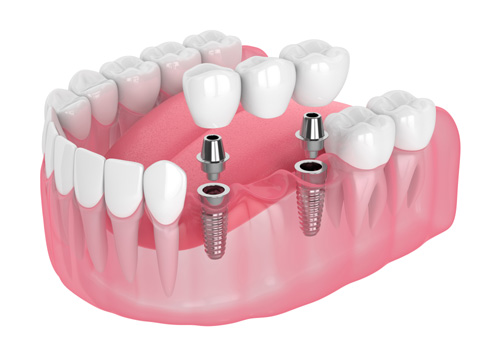
An implant-supported bridge is a fixed row of replacement teeth held in place by dental implants instead of by your natural teeth. Two or more implants are placed in the jawbone, and a single connected bridge is attached to them, filling a gap where several teeth in a row are missing. Because the bridge rests on implants, the healthy teeth on either side of the gap do not have to be filed down and crowned to hold it up, which is the main trade-off with a traditional bridge.
At Legacy Oral Surgery, our oral and maxillofacial surgeons plan and place the dental implants that support these bridges, then coordinate with your restorative dentist, who designs and fits the final teeth. Below, we explain how an implant bridge is built, which design fits which kind of gap, what the treatment sequence looks like, and what the research says about how long these restorations last. If you are weighing an implant bridge against a conventional bridge, our separate guide on why an implant-supported bridge may be better than a traditional bridge covers that comparison in detail.
How an Implant-Supported Bridge Is Built
Every implant bridge has three layers that work together. Knowing what each one does makes it easier to follow your treatment plan and understand why the process happens in stages.
The implants. Each implant is a small titanium post placed into the jawbone where a tooth root used to be. Over the following months the bone grows tightly against the implant surface, a process called osseointegration, which is what allows the implant to carry chewing forces.
The abutments. An abutment is the connector that sits on top of each implant and rises through the gum. It gives the bridge a secure attachment point and sets the angle and height of the final teeth.
The bridge. The bridge is one connected piece made of crowns over the abutments plus replacement teeth, called pontics, that span the spaces between them. A common example is two implants supporting a three-tooth bridge, where the middle tooth is a pontic with no implant beneath it. This is why you do not always need one implant per missing tooth. The bridge is either cemented onto the abutments or held with small screws, which allows your dentist to remove it for maintenance if needed.
Which Design Fits Which Gap
The right design depends on how many teeth are missing, where the gap is, and how much healthy bone is available. Your surgeon and restorative dentist choose the layout together using a clinical exam and 3D imaging.
Standard Implant Bridge
This is the most common design. An implant at each end of the gap supports the crowns and pontics in between. It is typically used when three or more neighboring teeth are missing, though it can also replace two adjacent teeth when bone and spacing allow.
Cantilever Implant Bridge
In a cantilever design, the replacement tooth extends beyond the last implant rather than sitting between two supports. It is sometimes used where bone or anatomy makes it hard to place an implant at one end of the gap. Because the extended tooth places more leverage on the implant, cantilevers are planned carefully and are usually kept short.
Full-Arch Implant Bridge
When all of the teeth in one jaw are missing or failing, a full arch of fixed teeth can be attached to four or more implants. This approach is often called All-on-4 or All-on-X, and we cover it in depth on our All-on-4 dental implants page. If you would prefer teeth that snap in and out for cleaning, that is a different restoration called an implant-supported overdenture rather than a fixed bridge.
If only one tooth is missing, a bridge is usually not needed at all. A single-tooth implant with its own crown replaces that tooth without involving its neighbors.
What the Treatment Sequence Looks Like
An implant bridge is completed in stages because each step has to heal before the next one begins. The general order is the same for most patients, although the timing varies with bone quality and whether extra procedures are needed.
- Consultation and imaging: Your surgeon reviews your health history and uses 3D imaging to measure bone height and width and to map nerves and sinuses near the planned implant sites.
- Preparatory procedures, if needed: Teeth that cannot be saved are removed, and areas with too little bone may need a bone graft before or at the same time as implant placement.
- Implant placement: The implants are placed under local anesthesia, with sedation available for patients who want it. A temporary restoration may be provided so you are not without teeth in a visible area.
- Healing and integration: The implants bond with the surrounding bone over a period of months. Our overview of the stages of dental implant healing walks through what happens during this phase.
- Abutments, impressions, and the final bridge: Once integration is confirmed, abutments are attached, impressions or digital scans are taken, and your restorative dentist fits the finished bridge.
Throughout this process our surgical team and your dentist share imaging and treatment notes so the implant positions match the bridge design that will eventually sit on top of them.
Who Is a Good Candidate
Good candidates have enough healthy jawbone to hold the implants, gums free of active disease, and general health that supports normal healing. A full exam is the only way to confirm candidacy, but several factors come up often.
Active gum disease needs to be treated and under control before implants are placed, because the same bacteria that damage gums around natural teeth can inflame the tissue around implants. Bone that has thinned after long-standing tooth loss can often be rebuilt with grafting. Smoking and poorly controlled diabetes raise the risk of complications, so we discuss these openly during planning. Your restorative dentist will also check that any decay or problems in your remaining teeth are addressed, since the new bridge works alongside them.
How Long Implant Bridges Last
Implant bridges have a strong track record, but they are not maintenance-free. A systematic review published in Clinical Oral Implants Research pooled 32 studies of implant-supported fixed bridges. It estimated that the implants themselves survived at a rate of 95.6% after 5 years and 93.1% after 10 years. The bridges built on them survived at 95.4% after 5 years and 80.1% after 10 years, and the 10-year figure rose to 93.9% when the analysis was limited to metal-ceramic bridges rather than older gold-acrylic designs.
The same review found that complications were common even when the bridge survived. Only about two-thirds of patients had no complications of any kind over 5 years. The most frequent problems were chipped veneering material, inflammation of the gum and bone around implants, and loosened screws or abutments. Most of these can be repaired, which is why the authors recommended that patients stay in a structured maintenance program after treatment.
Caring for Your Implant Bridge
Daily care focuses on keeping plaque away from the gumline around each implant and under the pontics. Brushing twice a day with a soft brush, cleaning under the bridge with floss threaders, interdental brushes, or a water flosser, and keeping regular cleanings and exams with your general dentist all help protect the gum and bone around the implants. If you grind or clench your teeth, a night guard may be recommended to protect the porcelain.
Call your dentist or our office if you notice bleeding or swelling around an implant, a bridge that feels loose, or a change in how your teeth come together. These are easier to manage when they are caught early.
Talk With Legacy Oral Surgery About an Implant Bridge
Our surgeons perform implant placement and the bone and soft tissue procedures that sometimes come before it at our Union City, Elizabeth, and Staten Island offices. We review your imaging with you, explain whether a standard, cantilever, or full-arch design fits your situation, and work alongside your restorative dentist from planning through the final bridge. Our implant-supported bridges page has more detail on how we approach this treatment.
Cost depends on the number of implants, whether grafting is needed, and the bridge materials, and our team can review insurance and financing options with you before treatment begins. To schedule a consultation, please fill out our contact form.
Frequently Asked Questions About Implant-Supported Bridges
How many implants does an implant-supported bridge need?
Most implant bridges replacing a short row of teeth use two implants, one at each end of the gap, with replacement teeth suspended between them. Longer spans may need three or more implants, and a full arch of fixed teeth usually rests on four or more. The exact number depends on the length of the gap, the forces in that part of the mouth, and the bone available, which your surgeon measures with 3D imaging.
Is an implant-supported bridge removable?
No. An implant-supported bridge is fixed, so you do not take it out at home. It is either cemented or screwed onto the abutments, and a screw-retained bridge can be removed by your dentist for professional cleaning or repair. If you want teeth you can remove yourself, ask about an implant-supported overdenture, which snaps onto implants and comes out for cleaning.
How long does it take to get an implant-supported bridge?
Treatment usually spans several months. After the implants are placed, the bone needs time to integrate with them before the final bridge is attached. If teeth need to be removed or bone needs to be grafted first, the timeline is longer. In some cases a temporary restoration can be placed while you heal. Your surgeon will give you an estimated timeline after reviewing your imaging.
Does getting an implant bridge hurt?
Implant placement is done under local anesthesia, and sedation is available for patients who prefer it, so you should not feel pain during the procedure. Soreness and swelling for a few days afterward are common and are usually managed with prescribed or over-the-counter pain relievers, cold compresses, and a soft diet. Later steps, such as attaching abutments and fitting the bridge, are generally much less involved.
Can I get an implant bridge if I have lost bone in my jaw?
Often, yes. When the jawbone has thinned after tooth loss, a bone graft can rebuild the area so it can support implants. Depending on the defect, grafting is done before implant placement or at the same appointment. In the upper back jaw, a sinus lift may be used to add bone height. Your surgeon will explain which approach fits your anatomy during your consultation.